Adult CMS: What a Paysite Content System Actually Needs
An adult CMS is not WordPress with a paywall bolted on. Here is what a paysite content system must handle, from high-risk billing to age checks and DMCA.
Most operators evaluating an adult CMS start by asking whether it is basically WordPress with a paywall. It is not, and that framing is where the budget overruns begin. An adult content management system has to do everything a normal CMS does, then carry the parts a mainstream platform never touches: high-risk recurring billing, age verification, 2257-style record-keeping, DMCA takedowns, and content moderation at scale. Those are not plugins you add later. They are the reason a generic CMS cannot run a paysite, and the reason the build-versus-buy decision here looks nothing like a normal web project.
Why a generic CMS cannot run a paysite
A CMS you already know, WordPress, Ghost, or Webflow, manages pages and posts. A paysite CMS manages money, identity, and legal liability on top of content. That gap is not something a membership plugin closes.
Consider what happens the moment you take a recurring payment for adult content. You need a processor that will knowingly accept adult transactions, which rules out Stripe, PayPal, and Square outright. Stripe names adult content in its restricted businesses, and the others enforce the same ban. So the billing layer cannot be a stock plugin pointed at a mainstream gateway. It has to integrate a specialist high-risk acquirer and handle rebills, dunning, refunds, and a chargeback ratio the card networks watch closely.
Then add the obligations that attach to the content itself: verifying every performer’s age and identity, retaining 2257-style records, responding to DMCA notices, and gating the whole site behind age assurance in jurisdictions that now require it. A generic CMS treats all of this as someone else’s problem; an adult CMS has to treat it as core schema. That is the structural difference, and it is why “just use WordPress” quietly becomes a six-figure integration project.
What an adult CMS has to handle
Every capability below is a system, not a setting. This is the checklist that separates a real paysite CMS from a blog with a login wall.
| Capability | Why a generic CMS falls short | Operator exposure if it is missing |
|---|---|---|
| High-risk recurring billing | Stock plugins target Stripe/PayPal, which ban adult | No revenue, or funds frozen mid-month |
| Age verification / assurance | No native identity-check layer | Legal liability under the OSA and US state laws |
| Performer KYC + 2257 records | No identity-retention model | Criminal and platform-ban risk |
| PPV, paid DMs, tips | Membership plugins do subscriptions only | Capped revenue per fan |
| DMCA + leak response | No takedown workflow or fingerprinting | Chargebacks, brand damage |
| Chargeback + fraud tooling | No high-risk fraud rules | Ratio breach, processor loss |
| Content moderation at scale | Spam filters, not illegal-content screening | Platform shutdown |
The billing row alone is why operators who start on a generic stack end up rebuilding: the mechanics are laid out in adult payment gateways for fansites. Taken together, an adult CMS is the same category of product covered in the clone-script comparison. The real question is never the feature list, every option claims subscriptions and PPV. It is who builds and maintains the seven systems above.
Self-hosted paysite CMS vs managed: the real cost
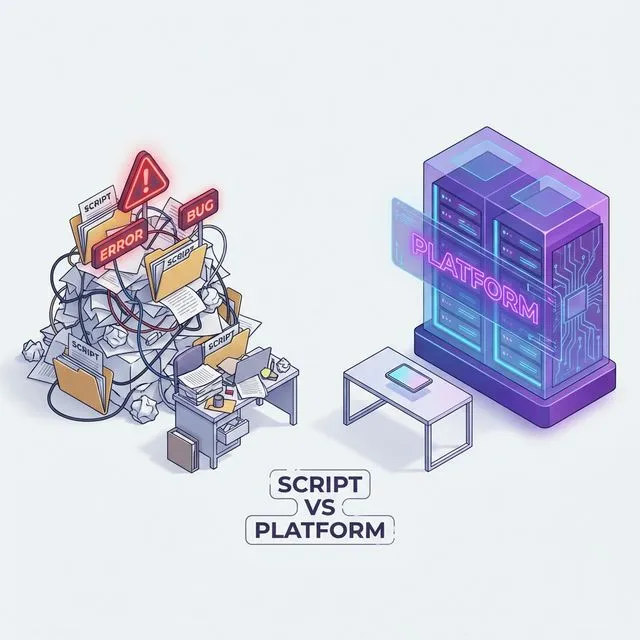
There are two ways to get an adult CMS. License a self-hosted script (Scrile, xFans / Adent.io, Fanso) and run it yourself, or use a managed white-label where the CMS and its compliance plumbing are operated for you.
The license price is the visible number and the smallest one. A self-hosted paysite CMS is a codebase you now host, secure, patch, and integrate. That means a server budget, a DevOps hire or contractor ($90k-140k/yr for full-time, or an ongoing agency retainer), a high-risk processor you source and underwrite yourself, and a compliance stack you assemble from age-verification vendors and legal review.
| Cost line | Self-hosted paysite CMS | Managed white-label |
|---|---|---|
| Software license | $5,000-$15,000 up front or monthly | Included in the plan |
| Hosting + infrastructure | $200-$2,000+/mo, yours to scale | Included |
| DevOps / maintenance | $90k-140k/yr or a retainer | Included |
| High-risk processor | You source, underwrite, hold the reserve | Provided or brokered |
| Age verification + KYC | You integrate and pay per check | Built in |
| Security patching + uptime | Your liability, around the clock | The platform’s liability |
The license fee is a down payment on a business you now have to staff. The build-your-own vs buy breakdown runs the three-way math (from scratch, script, or managed) in more detail.
What a self-hosted adult CMS actually costs to run
Put numbers on it. Take a mid-size operator: a self-hosted CMS license at $10,000, a $500/mo server that grows with traffic, a part-time DevOps contractor at $3,000/mo, and age-verification checks at $0.50-$2.00 per new user. At 1,000 new signups a month, identity checks alone run $500-$2,000. Before a single subscriber is billed, the operator is carrying $4,000-$6,000 a month in fixed operating cost plus the one-off license.
The revenue side behaves differently. High-risk processing takes 5-15% of transaction value against the 2.9% a mainstream site pays, so the payment cost is baked into every price regardless of which CMS you run. What the CMS choice changes is the fixed overhead: on a managed platform those infrastructure and compliance lines are spread across every operator on it, which is why the per-operator cost lands lower than standing the same stack up alone. An operator doing $20,000 a month in gross can be margin-positive on a managed CMS and margin-negative self-hosting the same feature set, purely on fixed-cost absorption.
Compliance is a CMS feature, not an add-on
The fastest-moving risk in this category is regulatory, and it lands on the CMS. Age assurance is now a legal requirement, not a courtesy checkbox. The UK’s Online Safety Act requires robust age verification for sites hosting adult content, and a growing list of US states have passed their own age-verification laws. A CMS that cannot gate access and prove it did is a liability the moment it goes live in those markets.
Underneath that sits performer compliance: KYC on every creator, 2257-style age and identity records retained and producible on request, and a DMCA workflow for takedowns. None of this is deferrable to version two. It determines whether the platform is legal to operate at all, and the detail is in age verification for adult platforms. The structural point: on a self-hosted CMS every one of these obligations is yours to build, integrate, and keep current as the law changes; on a managed platform they are maintained centrally.
This is also where the audience splits. An operator building a business wants to own the platform and can absorb this overhead. A solo creator who never wanted to run a content system at all is usually better served by a managed creator platform such as Heduno than by standing up compliance plumbing for a single account.
How do you choose an adult CMS?
Since every option lists the same headline features, the choice comes down to who carries the operational load. Four questions cut through it:
- Does the billing layer include a high-risk processor, or do you source and underwrite one yourself?
- Are age verification and KYC built in and kept current with the law, or bolted on vendor by vendor?
- Who is liable for a security patch at 2am, for uptime, and for a chargeback-ratio breach?
- What does migrating off cost later? Self-hosted lock-in is operational, not contractual, and it compounds.
Answer those honestly and the cheapest license often turns out to be the most expensive system to run. An adult CMS is not a piece of software you buy once. It is a standing set of obligations, and the only real decision is which of them you want to own.
The decision underneath the software
Choosing an adult CMS is really choosing how much of a platform business you want to operate yourself. The generic-CMS route underprices the compliance and payment plumbing until it stalls the launch. The self-hosted-script route makes that plumbing your full-time job. The managed route trades a monthly fee for someone else carrying it. There is no wrong answer, only a decision about where your time and liability should sit.
Wick gives operators a fully managed, branded adult CMS on their own domain, with high-risk payments, age assurance, and compliance built in, and no servers or scripts to maintain. See Wick’s pricing