Adult Subscription Website Builder: The Operator's Guide
An adult subscription website builder must do more than host pages. Compare general builders, adult CMS scripts, and managed platforms on cost and payments.
An adult subscription website builder is supposed to get you from idea to a paid, branded site fast: pick a template, drop in your logo, wire up a subscribe button. What the category rarely tells operators is that the builder is the cheap half of the decision. The expensive half is everything that turns a good-looking page into a business that bills reliably, stays inside card-network rules, and keeps creators and subscribers where you put them. This guide sorts the real options by that test rather than by how the demo looks, because the tool that wins the demo is often the one that stalls at launch.
What “adult subscription website builder” actually covers
The phrase points at three very different products, and conflating them is where launch budgets quietly disappear.
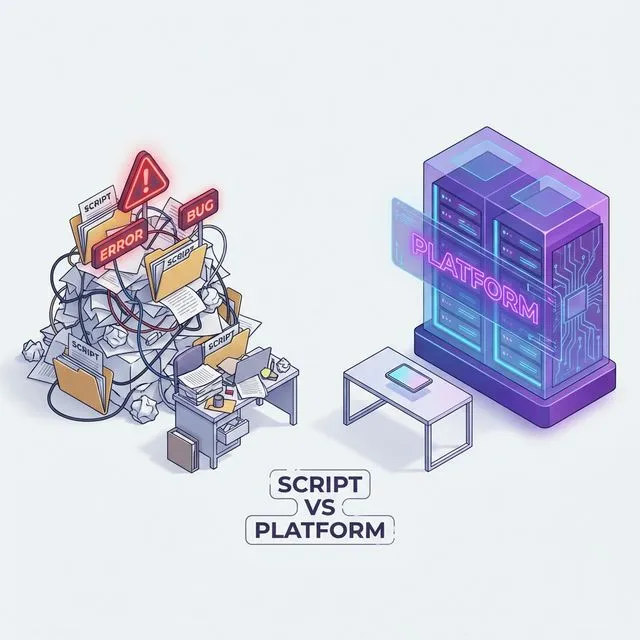
At one end sits the general-purpose site builder: Wix, Squarespace, or WordPress with a membership plugin. In the middle sit adult-specific content management systems and clone scripts, software you license once and then host and run yourself. At the far end are managed white-label platforms that operate the entire stack and hand back a branded adult subscription site on your own domain. Same search term, three business models, three cost curves. An operator weighing a $29 Wix plan against a revenue-share platform as though they were the same purchase is comparing a chassis to a finished car.
The rest of this guide treats those three as the real shortlist. What separates them is not the front end, which all three do competently. It is whether the parts that make money and keep you legal are included or left for you to assemble.
The three routes, side by side
| Route | What you actually get | Adult payments built in | Age assurance and compliance | Time to first paid signup | Cost shape |
|---|---|---|---|---|---|
| General site builder (Wix, WordPress) | Pages, templates, media hosting, a checkout button wired to a mainstream processor | No, and the processors ban adult outright | None; you build it | Fast to publish, then blocked at payment | Low fixed fee, huge hidden integration cost |
| Adult CMS or clone script (Scrile, xFans) | Full fansite software you own and self-host | No; you source your own high-risk acquirer | None; you implement KYC and age checks | Weeks of setup and integration | Licence plus servers, DevOps, and processor fees |
| Managed white-label platform (for example Wick) | A branded site with payments, compliance, and payouts already running | Yes, high-risk acquiring included | Yes, age assurance and KYC included | Hours to a live, billing site | Monthly plan plus a small commission, little or no setup |
Read the table across the “payments” and “compliance” columns and the pattern is blunt. The general builder is disqualified before you take a single card, because the mainstream processors it connects to will not accept an adult subscription. A clone script clears that bar, but the price of ownership is the entire operational burden landing on you. The managed platform absorbs both, and charges for it as a share of revenue rather than an up-front bill.
Wick sits in that third row, so it belongs in the open here rather than implied. Against a self-hosted clone script it is less flexible: you cannot rewrite the core engine, and at very high volume a commission can cost more per transaction than a processor contract you negotiated yourself. What it removes is the part that sinks most launches, the acquiring relationship and the compliance stack, and it removes the weeks those take. Where a script is the better fit, usually a team with in-house engineering and the scale to justify it, this guide says so plainly in the last section.
The feature checklist that decides which one builds a business
Payments aside, the difference between a website and a subscription business is a short list of operating functions. A builder that renders a beautiful profile but leaves these to you has sold you a shell.
- Recurring billing that recovers failed charges. Adult cards fail and expire at high rates. Without automated dunning and retries, involuntary churn quietly erases a tenth or more of monthly revenue before anyone notices.
- Creator onboarding with KYC. Every performer needs identity and age verification on file, tied to the content they post. On a plain builder that is a manual folder of documents; on a real platform it is a step in signup.
- Pay-per-view and paid messaging. On most fansites the subscription is the floor and PPV plus tips are the ceiling. A builder without a metered messaging and unlock system caps your average revenue per user at the subscription price.
- Payouts to creators. Splitting revenue across performers, holding tax details, and paying out cross-border is its own accounting product. Doing it by spreadsheet stops working at the third creator.
- Retention signals. Cancellation flows, win-back offers, and cohort reporting are what turn a launch spike into a book of recurring revenue. Most builders show you page views, not churn.
Score any tool against that list before you look at themes. The general builder scores near zero on it, which is the real reason it fails as a business tool rather than a publishing one. A clone script can tick most boxes, but every tick is code you now maintain. A managed platform ships the list as product. For a fuller view of the operational side, the creator management platform guide breaks down what agencies running multiple performers actually need day to day.
The one thing no builder bolts on afterwards
Everything above can, in theory, be assembled. Payments and compliance are the exception, and they are worth stating once and then deferring, because they decide whether the site can legally take money at all.
Mainstream processors prohibit adult subscriptions, so you need a high-risk acquirer, a merchant account in your name, and the reserve it holds against your volume. On top of that, Visa and Mastercard require documented consent and verified age for every monetised piece of content, and regulators have moved the same way. The UK Online Safety Act has required highly effective age checks on adult sites since July 2025, with Ofcom enforcing, and by 2026 roughly two dozen US states carry their own age-verification statutes. Stripe spells out the ban in its restricted businesses list; the other mainstream names enforce it the same way. This is the hard half of the build, and it is covered in depth in the companion piece on what an adult website builder leaves you to solve. The short version for this guide: if your chosen route does not include high-risk acquiring and age assurance, you have not chosen a subscription platform yet, you have chosen a front end and a second project.
What should you ask a builder vendor before you sign?
A demo shows the front end. Before you build an adult subscription site on any route, put these questions to the vendor: they show the business underneath, and a vendor who dodges one has told you which half of the product is missing.
- Who is the merchant of record, and whose name is on the acquiring account?
- What reserve is held, for how long, and what happens to it if you leave?
- Is age assurance included, or is it a separate contract you sign with another provider?
- Can you export your subscriber list, content and creator records in full?
- What does the vendor do when a chargeback ratio climbs? Visa now scores a combined fraud-plus-dispute ratio through its Acquirer Monitoring Program, and a platform that ignores the number will not warn you before the acquirer acts.
The export question matters most. A builder that cannot hand your audience back is not a platform you own, whatever the marketing says.
What does each route cost in year one?
Sticker price and real price diverge fast once you follow the money past month one.
A general builder runs $15 to $50 a month, then stops you at checkout, so its true cost is the abandoned launch plus whatever you spend rebuilding elsewhere. Self-hosted clone scripts start at a licence of a few hundred to a few thousand dollars, then carry the recurring reality underneath: adult-friendly hosting, a DevOps hire or contractor at $90k-140k a year if you scale, and a high-risk processor taking 5-15% of every transaction with a rolling reserve of 5-10% of volume held for around six months. On $50,000 of monthly volume that reserve alone parks roughly $30,000 of your cash with the acquirer once the window fills. A managed platform folds hosting, acquiring, and compliance into a revenue share, so the fixed cost drops toward zero and the variable cost rises with success. The cost-to-build breakdown models these lines against a real launch budget.
The number that rarely reaches the spreadsheet is time. Sourcing and underwriting a high-risk acquirer takes days to weeks before a single card clears. For an operator whose edge is getting a brand live while a niche is hot, launching this week instead of in two months is often worth more than any per-transaction saving. That is the calculation the white-label versus custom build guide runs in detail.
Which route fits which operator?
The honest answer depends on who you are, and pretending one tool wins for everyone is how these guides lose the reader’s trust.
If you are a single creator who wants a branded presence and nothing more, a plain builder plus an existing platform to handle the money is fine, and standing up your own high-risk merchant account would be overkill. The volume rarely justifies the reserve or the compliance work. A single creator is usually better off on a platform that runs the infrastructure for them than operating one alone.
If you run an agency or a brand with multiple performers and revenue you intend to own, the general builder is off the table and the real choice is script versus managed. Pick the self-hosted script when you have in-house engineering, the volume to make a negotiated processor contract cheaper than a revenue share, and a reason to control the code. Pick a managed white-label platform such as Wick when speed, compliance cover, and a predictable operating burden matter more than per-transaction margin, which describes most operators below serious scale. The trade is real either way: the script buys control at the cost of becoming an infrastructure company first, and the platform buys speed at the cost of a revenue share and a core engine you do not own.
Strip away the templates and the decision was never which builder has the nicest theme. It is whether an adult subscription website builder hands you a business that already bills and complies, or a page that still needs one bolted underneath it. Answer that, and the shortlist answers itself.
If you want the outcome a clone script promises without hosting, patching, and underwriting one yourself, Wick runs the whole platform on your brand and domain, payments and compliance included. Compare your options