OnlyFans Clone Script vs White Label: What a PHP Script Really Costs
Thinking of buying an OnlyFans clone script? Read this first. We compare self-hosted PHP scripts vs. modern white-label platforms like Wick.
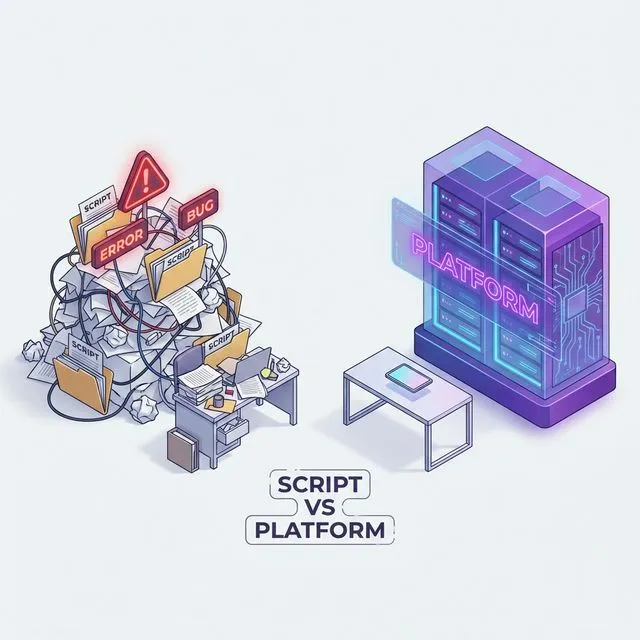
Search “OnlyFans clone script” and you will find dozens of marketplaces selling PHP packages for $49 to $999. Nearly all of them are PHP. The pitch never changes: pay once, own the code, launch this weekend. The OnlyFans clone script vs white-label decision looks like a simple cost comparison at that point, one-time fee against a monthly platform fee. It is not. The sticker price is the smallest number in the whole exercise, and the gap between the two models is not about software. It is about who carries the operational load once real users and real money show up.
Option 1: the PHP OnlyFans clone script (self-hosted)
These are usually PHP packages, often Laravel or a WordPress derivative, sold on marketplaces like CodeCanyon. You download a zip, install it on a server you rent, and the rest is yours.
The appeal is real for the right buyer:
- One-time cost. You pay once and own the files.
- Code access. You can edit the source, if you have the developer to do it.
The problems are also real, and they compound:
- No video infrastructure. Storing and streaming 4K video is expensive and hard. Scripts do not solve it. You configure your own storage buckets and CDN, wire up transcoding yourself, then pay for every gigabyte that streams.
- Payment processing is your problem. Most high-risk processors will not touch an unknown PHP script running on a random VPS. Getting approved on your own can take weeks.
- Support is a forum. When the script breaks at 2am on launch night, and it will, there is no one on call.
A clone script is a fine choice for a hobby build or a developer who wants to learn the stack. As the foundation of a business that has to stay online and take payments reliably, it starts working against you almost immediately.
How to judge an OnlyFans clone script solution before you buy
If you are going to buy one anyway, most of the risk can be read off the listing before you pay. Four checks do most of the work.
The PHP version it runs on. PHP 8.1 stopped receiving security fixes on 31 December 2025, and 8.2 follows on 31 December 2026, according to the official PHP supported-versions table. A script that only installs on 8.1 or older is already running on a language release nobody patches. Ask the seller which version it is tested on, then ask when they last shipped an update.
The changelog matters nearly as much. A script whose last release is more than a year old has, in practice, been abandoned, whatever the product page says. Check whether the license covers updates at all or only the download; on many marketplaces, support expires after six months unless you renew it.
Then ask the payment question in writing: which high-risk processors has the script been integrated with in production, not in a demo? A checkout wired only to Stripe or PayPal is a checkout you cannot use for adult subscriptions. Last, look for age verification and creator KYC. If the answer is “add a plugin”, that is your compliance programme now.
A script that clears all four is a reasonable starting point for a developer-led team. A script that fails two of them is a rebuild with a head start, and should be priced as one. The ranked comparison of clone scripts applies the same lens to the named products.
Why “onlyfans sql injection” is a warning, not a search
One of the most common searches around clone scripts is “onlyfans sql injection.” That is not researchers looking for vulnerabilities. It is operators discovering, usually too late, that the cheap script they bought leaks data.
Marketplace scripts rarely receive security patches after purchase. A single SQL injection flaw, one of the oldest and most preventable web vulnerabilities on the OWASP list, can expose your entire user table: emails, message history, and in the worst cases payment details. On an adult platform, that is not just a breach. It is a list of paying subscribers whose identities are now public, and a liability that lands squarely on you as the operator. The code you “own” is also the code you are responsible for patching, forever, on a schedule set by attackers rather than by you.
Option 2: the white-label platform (managed)
A white-label platform inverts the ownership model. You do not download the code. You lease a managed system, point your own domain at it, and run your brand on top while the provider operates the machinery underneath.
| Factor | Clone script | Managed white-label (Wick) |
|---|---|---|
| Launch time | Days to weeks of setup | Hours |
| Video infrastructure | You build and pay for it | Included |
| Payments | You source high-risk processing | Provider is merchant of record |
| Security patches | Your responsibility | Handled centrally |
| Support | Community forum | Managed |
| Cost shape | One-time + hidden ongoing | Recurring platform fee plus a 1% to 3% commission |
Wick is the right-hand column, so treat this as a comparison with a side rather than a neutral one. The trade-off is honest and it cuts against us in two places: you pay a recurring plan fee plus a 1% to 3% commission on revenue, and you cannot rewrite the core engine, so a script is cheaper at scale and a script is the only one of the two that leaves you owning something. For an operator whose job is recruiting creators and growing revenue rather than maintaining servers, neither of those is the constraint that matters. For an operator who wants the asset, or whose product has to work in a way no provider supports, both are decisive and the script is the correct answer.
The hidden costs of a clone script
The script might cost $200. Running it costs far more, and the ongoing numbers dwarf the license the moment you go live:
- Server and CDN: $150 to $1,200 a month once video traffic is real.
- Developer time: $50 to $150 an hour, every time something breaks or needs a security fix.
- Payment gateway setup: $500 to $2,000+ per high-risk application, with no guarantee of approval.
- Compliance tooling: age verification and record-keeping systems you now have to buy or build.
A managed platform folds those into one predictable line item. That is the real comparison behind the economics of running an OnlyFans clone: not license versus fee, but a front-loaded, unpredictable cost stack versus a known monthly one.
Payments and compliance: the part scripts leave to you
This is where self-hosting hurts most, because it is the part that is hardest to fix after launch.
Adult content is high-risk. Mainstream processors decline it, and the ones that accept it demand PCI-compliant infrastructure and can freeze funds on short notice. Stripe publishes exactly which adult and adult-adjacent categories it restricts in its restricted businesses list, and sourcing a stable high-risk payment processor on your own is a project in itself. Compliance is the second liability. Age assurance is now a legal requirement in major markets: the UK’s Online Safety Act mandates robust age verification for adult platforms, with real fines for operators who fall short. Buy a script and every one of these obligations is yours to build and defend. Lease a managed platform and they sit with the provider that is already the merchant of record.
What migrating off a clone script later costs
Operators rarely factor in the exit. A clone script feels like ownership until you outgrow it, and then the lock-in reveals itself as operational rather than technical. Your users, their payment tokens, their subscription histories, and their content all live inside a schema you now have to export, clean, and re-import somewhere else without breaking active billing.
The people who hit this wall usually do so at the worst time: after a security scare, a processor freezing funds, or traffic outgrowing a single server. Migration then becomes a rushed project with paying subscribers watching. A managed platform does not remove the cost of switching entirely, but it does mean the infrastructure, payments, and compliance were never yours to untangle in the first place. You are moving a brand, not rebuilding a company. That difference is the same one that separates buying a script from building your own OnlyFans versus buying a managed platform: where the operational weight sits, today and on the day you want out.
Which is better for your business?
If your goal is to write code, buy a script. If your goal is to run a subscription business, the script is a liability wearing the costume of a bargain. And if you are a creator rather than an operator, neither column is aimed at you: a personal platform for performers who want their own domain (Heduno, our creator infrastructure) gives you the address and the storefront without the operator’s job. Your time is better spent recruiting creators and cutting churn than debugging PHP and chasing security patches. For the step-by-step on the managed route, see how to launch your own OnlyFans site.
Your platform runs on Heduno, the creator infrastructure Wick operates, so the servers, the high-risk processing and the compliance work are ours, and the domain and the brand are yours. See the plans